Why Legal AI Fails Without Trusted Document Context
Document Context in Legal AI
Why Legal AI Fails Without Trusted Document Context
Thought Leadership | netDocShare | Metadata, Permission and Retention Across Platforms
A legal AI assistant can give you an answer in seconds. But how much should you trust that answer?
The problem may not be the AI model itself. It may be the documents and information the AI is working with.
Consider a simple example. A knowledge manager at a mid-size law firm asks an AI assistant to find every non-disclosure agreement related to a particular client matter. The assistant quickly returns five documents. Two of them, however, belong to another client with a similar file name.
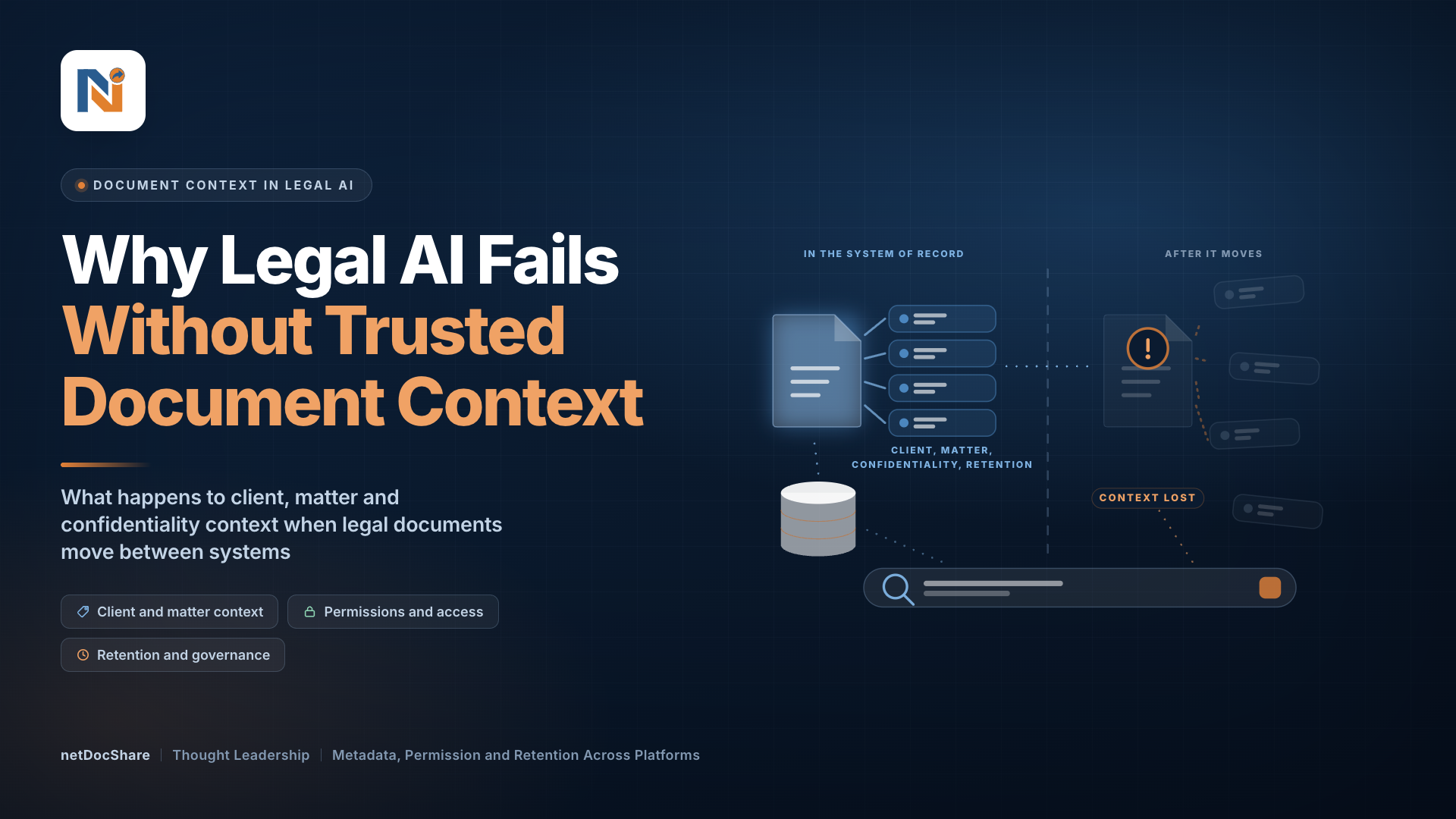
The AI did not necessarily misunderstand the documents. The problem was that important information about those documents including their client and matter context was missing after they moved between systems.
This is an increasingly important issue as law firms bring AI into everyday document search, review, and knowledge of workflows.
The Information Behind the Document Matters
A legal document is more than the words on the page.
A contract might look like an ordinary Word or PDF file, but information around that document can determine how it should be handled:
-
Which client does it belong to?
-
Which matter is it associated with?
-
Is it confidential?
-
Who created it?
-
Who should have access?
-
Does it contain privileged information?
-
How long should it be retained?
This information is commonly stored as a metadata.
Think of metadata as the label attached to a legal file. The document might say Non-Disclosure Agreement, while the metadata tells the system which client, which matter, and what restrictions apply.
When that context is accurate, AI has a much better foundation for finding and interpreting the right information.
When it is missing or incorrect, even a sophisticated AI system can produce an answer that sounds convincing but is wrong.
A Simple Example
Imagine a law firm that has 200 NDAs across dozens of client matters.
A lawyer asks:
“Show me the NDAs for Client A's acquisition matter.”
If the documents are correctly tagged with the client and matter information, the system can narrow the results appropriately.
But suppose several documents lost those tags during a migration. The AI may still recognize the words “NDA” and “acquisition,” but it may not know which client the documents actually belong to.
The result can look perfectly reasonable while being completely wrong about the matter.
That is the real danger: AI can be confidently wrong when the underlying document context is unreliable.
When Document Context Gets Lost
egal documents rarely stay in one system. A file may move from a document management system to SharePoint, Teams, or another repository. The risk is not simply that the file moves, it is that important context may not move with it.
For example, a document marked “Outside Counsel Eyes Only” in a firm's document management system may be copied into a Teams channel without the same classification or restriction. The document itself is still there, but the information explaining how it should be handled may be missing.
This becomes especially important when AI can search across those systems. A document that was difficult to discover before may suddenly appear in response to a natural-language query.
The problem is that AI makes missing context and existing access gaps much easier to expose.
The Bigger Risk: Finding Documents People Should Never See
Incorrect AI answers are one problem.
Access to the wrong information is another.
Microsoft has stated that Copilot works within the permissions already assigned to users; it does not simply bypass those permissions. That means the quality of an AI search is closely connected to the quality of the access controls underneath it.
Consider another example.
A junior associate was once part of a large matter team and retained access through an old group membership. Years later, that access was never removed.
Before AI, the associate would probably never encounter documents from that matter unless they actively searched for them.
Now they can ask:
“Find all documents relating to the previous client dispute involving Company X.”
If the permissions are still too broad, AI makes that old access much easier to exploit, even unintentionally.
For a law firm, the consequences can involve confidentiality, privilege, conflicts, and client trust.
AI does not create every governance problem. It makes existing problems much easier to discover.
Figure 1
How a missing field becomes a legal risk
The Numbers Behind the Problem
The legal industry is rapidly increasing its use of AI, while concerns about data readiness and infrastructure remain.
Gartner research cited in the original analysis found that 63% of organizations either lack or are unsure they have the data-management practices required to support AI, and Gartner projected that 60% of AI initiatives through 2026 would be abandoned because of data that was not AI-ready.
At the same time, the 2026 General Counsel Report from FTI Consulting and Relativity reported that active AI use among general counsel had reached 87%.
The message is straightforward:
AI adoption is accelerating faster than many organizations are preparing the information underneath it.
What Should Law Firms Check?
Before expanding AI across a legal document environment, firms should ask a few basic questions.
-
1. Is document context consistent?
Are client, matter, confidentiality, privilege, and other important metadata fields accurate across repositories?
-
2. Does that context survive a migration?
When a document moves from one platform to another, does its relevant metadata and governance information move with it?
-
3. Are permissions still correcting?
Can people access documents simply because they were once added to a group, matter, site, or folder?
-
4. Can AI discover information that users technically have access to but should no longer have?
AI-powered search can expose old access-control problems that traditional workflows allow to remain hidden.
-
5. Who owns document governance?
IT, knowledge management, records teams, and practice groups may all manage different parts of the information environment. Someone needs to own the overall picture.
Where Document Management Becomes Critical
This is where the conversation should move beyond the AI model itself.
The quality of legal AI depends heavily on the quality of the document environment underneath it.
Solutions such as netDocShare become relevant not simply because they are another document platform, but because effective document management is part of the foundation required for trustworthy AI.
The important question is:
“Can our document environment preserve the right context, permissions, and governance as information moves through the organization?”
That distinction matters.
AI can make finding information dramatically easier. But easier discovery also increases the importance of having accurate document organization, controlled access, and reliable governance in place first.
Trustworthy AI Starts Before the Prompt
Legal AI is only as reliable as the information environment behind it. If documents have the wrong client or matter information, missing confidentiality controls, or incorrect permissions, even a capable AI system can produce unreliable results or expose information to the wrong people.
For law firms, getting the document foundation right is becoming an essential part of building AI that people can trust.
Before asking AI to understand your documents, make sure your documents have the right context.
Source: netDocShare thought leadership, “Why Legal AI Fails Without Trusted Document Context”. Figures cited in the article are attributed there to Gartner research and to the 2026 General Counsel Report from FTI Consulting and Relativity.